Donate to Marie Curie Cancer Care
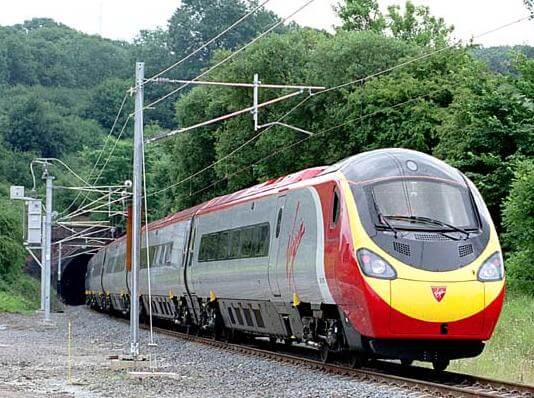
Whatever else Richard Branson has done, he will live forever in public infamy for his Virgin Train service.
You would think that a man who had made a good fist of running an international airline – something that is quite hard to do, probably – might be in with a chance of running a railway efficiently. Certainly none of his planes are ever three hours late into Los Angeles International Airport or have no sandwiches in Business Class or spend an afternoon standing outside Doncaster smelling of cabbage.
It’s a fair bet that Branson’s jumbo jets do not have overflowing toilets and that when you ask for some duty-free Scotch, the hostess will not say, ‘We haven’t got any, here’s a can of Kestrel instead’.
Why, it’s as though in the world of international airlines, Virgin are in hot competition with hundreds of other companies and have to be good and efficient to survive. Whereas in the world of national railways, they can do what they like because no-one else wants the job, and their only competition is Thomas the Tank Engine, who can only go as far as Budleigh Salterton before he has to have a lie-down.
Similarly, let’s not forget that Richard Branson made his millions not from trains but from his Virgin Records record company. Remember them, they belong to EMI or Daimler now, but back in the day, Virgin’s weird logo of two Siamese twins in the nude was a guarantee of musical quality.
Actually it wasn’t, it was a guarantee of some appalling hippy tosh with a 14-minute moog synthesiser solo taking the high ground on side four, but that’s not the point. Virgin Records was a successful, popular business.
Mind you, it’s unlikely it would have done well if W H Smith ran out of Mike Oldfield albums and instead handed out little forms that said, ‘We apologise for the non-arrival of Tubular Bells. This is due to slightly distorted guitars at Harpenden.
Please accept this voucher for five pence instead.’
Author unknown
